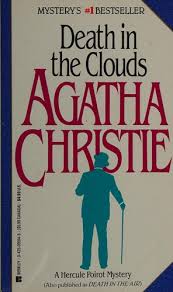
Death in the Clouds
👤| Published | March 10, 1935 |
| Genre | Detective Fiction, Mystery |
| Publisher | Collins Crime Club |
| Language | English |
| ISBN-10 | 000711933X |
| ISBN-13 | 978-0007119332 |
📝My Honest Review: Death in the Clouds
I really enjoyed this one, mostly because the setting is so unique. It’s a "locked-room" mystery set on a small passenger plane flying from Paris to London. What makes it so embarrassing for our hero is that the murder happens just a few feet away from Hercule Poirot while he is taking a nap! I loved seeing Poirot’s ego get a little bruised because he missed the crime as it happened.
The murder weapon is one of Christie’s most "exotic"—a poisoned dart supposedly fired from a South American blowpipe. At first, it sounds like a ridiculous spy movie plot, and even Inspector Japp pokes fun at how "sensational" it is. But as always with Christie, the flashy weapon is just a distraction from a much simpler, more clever truth.
The cast of suspects is a great cross-section of 1930s society: a dentist, a mystery writer (who Christie uses to make fun of her own profession), a hairdresser, and a French moneylender. The "romance" subplot between Jane Grey and Norman Gale is a bit predictable, but it gives the story a nice emotional core. My only complaint is that the solution relies on one very specific physical disguise that felt a little hard to believe in such a cramped space.
Overall, it’s a high-flying mystery (literally) that keeps the pace moving. It’s not quite as deep as *Murder on the Orient Express*, but the puzzle is top-tier and the clues are all there if you look closely at the passengers' luggage!
⏱️ 1-Minute Summary (for busy readers)
Hercule Poirot is traveling on the airliner *Prometheus* from Paris to Croydon. Mid-flight, a passenger named Madame Giselle—a notorious French moneylender and blackmailer—is found dead in her seat. Initially, it looks like a fatal wasp sting, but Poirot finds a poisoned thorn on the floor and a blowpipe tucked behind his own seat.
With eleven passengers and two stewards as suspects, the investigation reveals that almost everyone on board had a reason to want Giselle dead, from gambling debts to hidden family secrets. Poirot focuses on the "psychological impossibility" of someone using a blowpipe unnoticed and eventually realizes the killer used a brilliant disguise: they simply wore a steward's coat and moved in plain sight, knowing that nobody ever truly *looks* at a waiter or a steward.
💡 Key Ideas & Themes
🌱 Life Lessons / Takeaways
- Observe the "Ordinary": We often miss the most important things because we only focus on what is "unusual." True observation includes the people who are just doing their jobs.
- Don't be distracted by the "Sensational": A blowpipe and poisoned darts are distracting. In life, the most complex-looking problems often have very simple, human solutions.
- Money is a dangerous master: Many lives on the plane were ruined or controlled by debt. It's a reminder of the weight that financial secrets can carry.
🎯 Who Should Read This?
- Fans of Poirot who want to see him in a unique, modern setting.
- Travel lovers who enjoy "Golden Age" transportation vibes.
- Readers who like "list of suspects" puzzles with clear clues.
❌ Who Shouldn't?
- People with a phobia of wasps (it’s a major plot point!).
- Readers who prefer gritty, realistic police procedurals over "puzzle" mysteries.
🔹 My Honest Rating
| ⭐ Rating (Story, Writing, Value) | 4.0 / 5 A very entertaining, fast-paced puzzle that keeps you guessing. |
|---|---|
| 👍 What I Loved | The luggage inventory. Poirot asks to see every single item the passengers were carrying, and it's a brilliant way for the reader to try and solve the mystery themselves. |
| 👎 What I Didn’t Like | The killer’s plan relies a lot on luck. If one person had looked up at the wrong time, the whole plan would have failed instantly. |
| 😐 Overrated or Underrated? | Underrated. It’s usually overshadowed by *Death on the Nile*, but the "steward disguise" is one of the smartest tricks in any mystery book. |
| 🧠 What Changed My Thinking | It reinforced the idea that if you want to be "unseen," you shouldn't hide in the shadows—you should stand right in the middle of the room as someone "unimportant." |
👤 Author Context (Behind the Scenes)
Why she wrote this book: Agatha Christie was a huge fan of air travel. She took her first flight in 1911 and found it "extraordinary." She wanted to bring the "classic" mystery into the modern era of the 1930s.
Author’s mindset: You can see Christie having fun with the character of Daniel Clancy, the mystery writer. Through him, she makes fun of all the "rules" of detective fiction and how real-life crime is much messier than books.
Reception: Critics in 1935 called it "ingenious" and "first-rate." It cemented Poirot's reputation as a detective who could solve crimes not just in country houses, but on trains, boats, and now planes.
Discover Your Next Great Read
Handpicked recommendations from our collection of literary treasures






💬Discussions