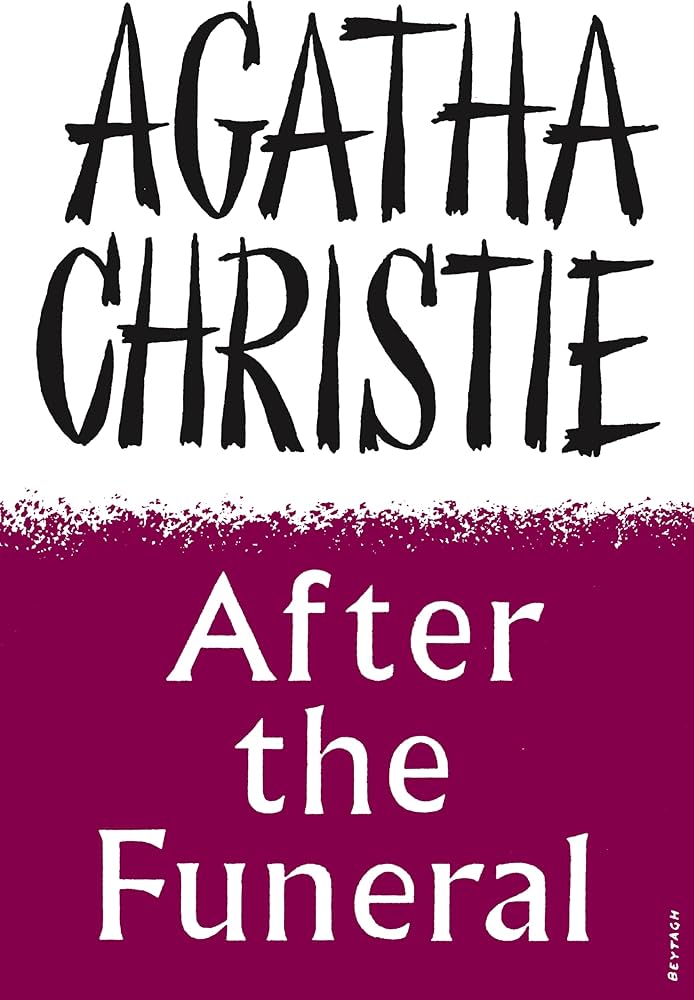
After the Funeral
👤| Published | March 1953 |
| Genre | Detective Mystery |
| Publisher | Collins Crime Club |
| Language | English |
| Series | Hercule Poirot #29 |
📝My Honest Review: After the Funeral
This book starts with a classic Christie zinger. At the funeral of the wealthy Richard Abernethie, his eccentric sister Cora blabs out: "But he was murdered, wasn't he?" The next day, Cora is found hacked to death with a hatchet. It’s a brutal, high-stakes hook that promises a lot. As Poirot notes during his investigation:
"It is the small things that are important. For a funeral, for instance, one should always have the correct clothes."
This quote is actually a massive clue, but as a critic, I have to say that the middle of this book is exhausting. The Abernethie family are a bunch of greedy, bickering vultures. While Christie is great at writing dysfunctional families, these characters lack the charm or wit found in her earlier books. You’re basically stuck in a room with five people who all hate each other, and frankly, you’ll probably end up hating most of them too.
Poirot also feels a bit "tired" in this one. By 1953, Christie was getting a little bored of him, and it shows. He spends a lot of time being mysterious without actually doing much until the very end. That said, the "trick" Christie uses to hide the killer is genuinely one of her most brilliant pieces of misdirection. It’s a "slap-your-forehead" moment that almost makes the boring middle section worth it.
⏱️ 1-Minute Summary (for busy readers)
Richard Abernethie dies of "natural causes," but his sister Cora suggests he was murdered. When Cora is found dead the next day, the family lawyer calls in Hercule Poirot. Poirot investigates the family members, all of whom had financial motives to see both Richard and Cora dead.
The twist is a masterclass in impersonation. Miss Gilchrist, Cora’s companion, murdered Cora before the funeral. She then disguised herself as Cora (using a slight padding and mimicking her head-tilt) to attend the funeral and drop the "murder" comment. Why? To make it look like Cora was killed to keep her quiet, shifting suspicion onto the rest of the family while Miss Gilchrist secured a valuable painting from Cora’s collection to start her own tea-shop business.
🔹 The Critic's Report Card
| ⭐ Rating | 3.7 / 5 Top-tier twist, but a bit of a slog to get there. |
|---|---|
| 👍 What I Loved | The visual clue. The way the killer is caught because of a mirror and a piece of cake is classic, fair-play Christie. |
| 👎 What I Didn’t Like | The suspects. They are very "grey" and hard to tell apart at times. It lacks a standout character like Lucy Eyelesbarrow or Hastings to keep things lively. |
| 😐 Overrated or Underrated? | Underrated. The solution is so good that it deserves to be mentioned alongside her most famous books. |
👤 Human Take: The "Desperation" of the Killer
The "human" part of this story is actually quite sad. The killer isn't a criminal mastermind; they are a lonely, middle-aged woman who is terrified of becoming a "decayed gentlewoman" with no money. She commits a brutal murder just for the chance to own a small tea shop. It shows how the fear of poverty can drive a "nice" person to do something absolutely horrific. It's a dark look at the social pressures of 1950s England.
The Final Word: It’s a slow, slightly depressing family drama with a 5-star ending. Read it for the "Aha!" moment, but keep some coffee nearby for the middle chapters.
Discover Your Next Great Read
Handpicked recommendations from our collection of literary treasures



💬Discussions