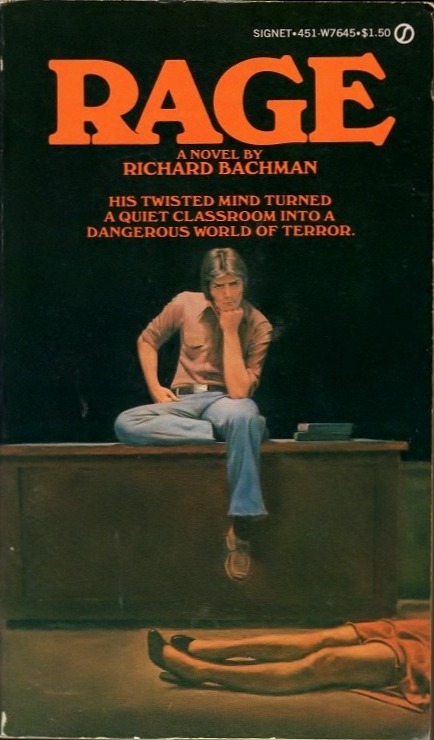
Rage
👤| Published | September 1977 |
| Genre | Psychological Thriller |
| Publisher | Signet Books |
| Language | English |
| Status | Out of Print (Author's Request) |
📝My Honest Review: Rage
Charlie Decker is a high school student who snaps. After a violent incident with a teacher, he sets his locker on fire and takes his algebra class hostage at gunpoint. But instead of a standard hostage thriller, the book turns into a bizarre "group therapy" session where the students begin to side with Charlie, sharing their own dark secrets and resentments. As Charlie reflects on the nature of his "rage":
"Everything that’s happened... it’s like a chemical reaction. Once it starts, you can’t stop it until the fuel is gone."
Now, let’s be critical. The prose is clearly the work of a very young writer (King wrote it in high school). It’s "edgy" in a way that feels hyper-focused on teenage rebellion and the perceived phoniness of adults. The biggest issue, however, is the romanticization of the situation. King makes Charlie a bit too charismatic, which is likely why he eventually requested the book be pulled from print after it was linked to real-life school incidents. It’s a dangerous piece of fiction that lacks the maturity of his later work.
The human horror here is the boiling point. It’s a terrifyingly accurate depiction of how isolation and a lack of empathy can turn a "normal" kid into a monster. It’s uncomfortable because it forces you into the head of someone doing something unforgivable, making you realize how thin the line is between social frustration and total collapse.
⏱️ 1-Minute Summary (for busy readers)
Charlie Decker takes his classroom hostage after killing two teachers. As the police surround the school, the classroom becomes a sanctuary where students air their grievances against society and their parents. The group eventually turns on the "perfect" student in the room, Ted Gallant, in a display of collective madness.
The finale is quiet and bleak. Charlie releases the students and attempts "suicide by cop." He survives the shooting, is found not guilty by reason of insanity, and is sent to a psychiatric hospital. The book ends with him unrepentant, writing a letter from the asylum. It’s a raw, nihilistic ending that offers no easy lessons or moral resolution.
🔹 The Critic's Report Card
| ⭐ Rating | 3.0 / 5 Visceral and intense, but rightfully retired from public sale. |
|---|---|
| 👍 What I Loved | The Intensity. The book moves like a bullet. It captures the "stifling" feeling of high school social hierarchies better than almost any other book of its era. |
| 👎 What I Didn’t Like | The Stockholm Syndrome. The way the entire class suddenly decides Charlie is a hero feels unrealistic and serves as a dangerous fantasy for a troubled audience. |
| 😐 Overrated or Underrated? | Overrated due to rarity. People hunt for this book because it's "banned," but as a story, it isn’t nearly as strong as The Long Walk. |
👤 Human Take: The Responsibility of the Storyteller
The "human" story of Rage isn't about the characters; it’s about Stephen King's decision to stop selling it. King realized that words have power, and sometimes that power can be used by the wrong people for the wrong reasons. It’s a sobering reminder that stories don't exist in a vacuum; they have consequences. This book is a dark relic of King's youth that serves as a case study for the weight of an author's influence.
The Final Word: It’s a grim piece of literary history. If you find a copy, read it as a study of a young writer's raw anger, but respect the author's choice to leave it in the past.
Discover Your Next Great Read
Handpicked recommendations from our collection of literary treasures

💬Discussions