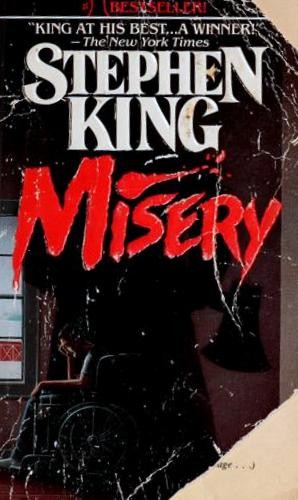
Misery
👤| Published | June 1987 |
| Genre | Psychological Horror / Thriller |
| Publisher | Viking |
| Language | English |
| POV | Limited Third Person (Paul Sheldon) |
📝My Honest Review: Misery
Paul Sheldon is a famous writer who wants to move on from his "Misery Chastain" romance series. After a car crash in a blizzard, he is "rescued" by Annie Wilkes—his number-one fan. But Annie isn't interested in his new high-brow literary work. She wants Misery back, and she’s willing to break Paul's legs to make sure he stays in bed and writes for her. As Annie calmly explains:
"I'm your number-one fan. There's nothing to worry about. You're going to be just fine. I'm going to take good care of you."
Now, let’s be critical. The "book-within-a-book" (the Misery's Return chapters) can be a bit polarizing. Some readers find the intentionally cheesy romance writing a distraction from the intense horror happening in the guest room. It can slow the pacing down right when you want to see Paul escape. Also, Annie’s "folksy" dialogue (using words like cockadoodie) can be grating, though it’s clearly meant to highlight her terrifying instability.
But the physicality of the horror is unmatched. King makes you feel every throb of Paul’s broken legs and every spark of the "Novril" addiction. It’s a claustrophobic nightmare. Unlike many King books, there is no "supernatural" out. Paul can't pray to a god or find a magic ritual; he has to use his own wits and his typewriter to survive a woman who is physically and mentally stronger than him.
⏱️ 1-Minute Summary (for busy readers)
Paul Sheldon kills off his popular character, Misery Chastain, in his latest book to pursue "serious" writing. After crashing his car in a remote part of Colorado, he wakes up in the home of Annie Wilkes, a former nurse with a dark past. When Annie discovers he killed Misery, she becomes violently psychotic.
Annie forces Paul to write a new novel, Misery's Return, specifically to bring the character back to life. Paul is subjected to horrific torture—most famously "hobbling" (which is even more gruesome in the book than in the movie)—as Annie oscillates between motherly care and murderous rage. In a brutal final confrontation, Paul uses his finished manuscript as a weapon and manages to kill Annie and escape, though he is left permanently disabled and traumatized.
🔹 The Critic's Report Card
| ⭐ Rating | 4.9 / 5 A tight, terrifying, and deeply psychological thriller. |
|---|---|
| 👍 What I Loved | The psychological warfare. Watching Paul try to "write for his life" while manipulating Annie's moods is incredibly tense. It’s a battle of minds. |
| 👎 What I Didn’t Like | The pacing of the inner-novel chapters. Sometimes they feel like they go on a few pages too long, breaking the tension of the main plot. |
| 😐 Overrated or Underrated? | Properly Rated. It is widely considered one of the best thrillers ever written, and for good reason. |
👤 Human Take: The Slavery of Fame
The "human" core of Misery is the idea that we can become prisoners of what other people want from us. Annie Wilkes is the personification of a toxic audience—the kind that thinks they "own" the creator. Every writer or artist has felt that fear: that if they try to change, they will be "punished." King just took that feeling and gave it an axe. It’s a story about the agonizing, bloody process of finding your voice again when someone else is trying to silence it.
The Final Word: It’s a masterpiece. It’s gruesome, yes, but it’s also a brilliant look at the relationship between a writer and his work. Just don't read it if you're planning a solo drive through the mountains!
Discover Your Next Great Read
Handpicked recommendations from our collection of literary treasures


💬Discussions