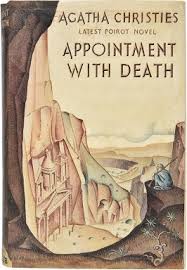
Appointment with Death
👤| Published | May 1938 |
| Genre | Detective Mystery / Psychological Study |
| Publisher | Collins Crime Club |
| Language | English |
| Series | Hercule Poirot #19 |
| Setting | Jerusalem and Petra, Jordan |
📝My Honest Review: Appointment with Death
Let’s be real: Mrs. Boynton is one of the most hateful characters Agatha Christie ever created. She’s not just a "mean mom"—she’s a psychological monster who treats her adult children like prisoners. Honestly, by the time she gets murdered halfway through the book, you aren't looking for a killer; you're looking for someone to give a medal to. That’s the strength of this book: the tension is so thick you can practically feel the heat of the Petra desert.
But here is where I have to be a critic. The first half is a brilliant psychological drama. You see these broken kids trying to escape their mother's shadow, and it’s genuinely gripping. But once Poirot arrives to solve the case in just 24 hours, the book shifts into a very "mechanical" mode. It becomes a repetitive cycle of interviews that feels a bit like a chore to get through compared to the high stakes of the beginning.
The solution? It's... fine. It makes sense logically, but it feels like it comes out of left field. The killer is someone who was barely on the radar for most of the book, which feels a bit like Christie cheated the reader out of a fair fight. It’s a good read for the atmosphere and the villain, but don't expect the legendary "brain-melt" twist of her top-tier novels.
⏱️ 1-Minute Summary (for busy readers)
The Boyntons are a family under the thumb of their sadistic matriarch, Mrs. Boynton. While on a trip to the ancient city of Petra, Mrs. Boynton is found dead in her chair. It looks like a heart attack, but a tiny puncture mark on her wrist suggests a lethal injection. Hercule Poirot happened to be nearby and is given 24 hours to solve the case before the group leaves.
Every family member has a motive, and most of them actually *think* someone else in the family did it. In the end, Poirot reveals that the killer wasn't a family member at all, but Lady Westholme. She was a former prisoner in a jail where Mrs. Boynton was once a warden. To protect her political career from being ruined by Mrs. Boynton's blackmail, Lady Westholme disguised herself as an Arab servant and delivered the fatal dose of digitoxin.
🔹 The Critic's Report Card
| ⭐ Rating | 3.5 / 5 Worth reading for the setting, but the ending feels a bit rushed. |
|---|---|
| 👍 What I Loved | The creepy atmosphere. Mrs. Boynton sitting there like a "monstrous swollen Buddha" in the mouth of a cave is an image that stays with you. |
| 👎 What I Didn’t Like | The ending. Lady Westholme feels like a "background character" for 90% of the book, making her the killer feel a bit unsatisfying. |
| 😐 Overrated or Underrated? | Underrated as a drama, Overrated as a mystery. As a story about a toxic family, it's 5 stars. As a puzzle, it's a 2. |
| 🧠 What Changed My Thinking | It made me realize that sometimes the "why" (the psychology) is much more interesting than the "who." |
👤 Real Talk: Why this book is "Human"
Christie actually spent a lot of time in the Middle East with her archaeologist husband, and you can tell. She isn't just guessing what Petra looks like; she knows the heat, the dust, and the feeling of being trapped in a camp. The "human" side of this book is the tragedy of the Boynton children. They are adults who have been so abused they don't even know how to be free. It’s actually quite sad, and Christie handles that heavy stuff better here than in almost any other book.
The Final Word: Read it if you want a dark, tense story about a family breaking point. If you want a "fair play" mystery where you can find all the clues yourself? You might find this one a bit annoying.
Discover Your Next Great Read
Handpicked recommendations from our collection of literary treasures
💬Discussions