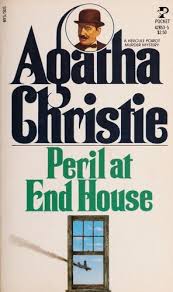
Peril at End House
👤| Published | February 1932 |
| Genre | Detective Fiction, Mystery |
| Publisher | Collins Crime Club |
| Language | English |
| ISBN-10 | 0007119313 |
| ISBN-13 | 978-0007119318 |
📝My Honest Review: Peril at End House
I absolutely loved this book. It starts with Poirot and Captain Hastings on vacation in Cornwall, and within minutes, a bullet nearly hits a young woman named "Nick" Buckley while she’s talking to them. It’s a brilliant hook because Poirot takes it as a personal challenge to his ego—he feels he must protect this girl before the "fourth time" is a success.
The atmosphere of "End House" is wonderfully gothic—a crumbling mansion on a cliffside. Nick is a great character: young, reckless, and seemingly surrounded by "accidents" like falling paintings and failed brakes. But as I read, I started to feel that something was slightly "off" about the way everyone was acting. Christie is a master at making you look at the wrong person by using your own sympathy against you.
This is one of the best examples of Poirot’s "Grey Cells" at work. He doesn't just look for clues; he stages a fake séance and a "ghostly" appearance to catch the killer. The middle section gets a bit heavy with talk about wills and inheritance, which can be a little dry, but the payoff at the end is so shocking that I had to go back and re-read earlier chapters to see how I missed the truth.
If you like mysteries where the "victim" is the center of the story, this is perfect. It’s fast, glamorous, and features a twist that ranks right up there with *The Murder of Roger Ackroyd*.
⏱️ 1-Minute Summary (for busy readers)
While vacationing in St. Loo, Poirot meets Magdala "Nick" Buckley, the owner of End House. She tells him about three recent "accidents" where she nearly died. When a bullet passes through her hat while talking to Poirot, he realizes someone is actively trying to murder her for her estate. To protect her, Poirot brings in her cousin, Maggie, as a companion.
Tragedy strikes during a fireworks party when Maggie is found dead, wearing Nick's red shawl—clearly a case of mistaken identity. Poirot investigates a mysterious pilot fiancé, a secret will, and a set of suspicious neighbors. In a dramatic finale, Poirot reveals that the "victim" was the killer all along. Nick had murdered her cousin to steal an inheritance from a dead pilot and had faked the "accidents" on herself to create a perfect alibi as a target.
💡 Key Ideas & Themes
🌱 Life Lessons / Takeaways
- Don't let sympathy blind your logic: Feeling sorry for someone makes you a bad judge of their character. Poirot reminds us to look at the facts, not the feelings.
- Evil can be charming: The most dangerous people aren't usually the ones who look "shifty"—they are often the most likeable people in the room.
- Small details tell the big story: The mystery is solved by noticing a tiny detail about a red shawl and a missing letter. The big picture is always made of small pieces.
🎯 Who Should Read This?
- Readers who love "unreliable" characters.
- Fans of seaside/vacation mysteries.
- Anyone who thinks they can outsmart Agatha Christie (good luck!).
❌ Who Shouldn't?
- Readers who find "inheritance/legal" plots boring.
- Those who dislike Poirot's occasional arrogance (he's very boastful here).
🔹 My Honest Rating
| ⭐ Rating (Story, Writing, Value) | 4.8 / 5 An absolute classic. The twist is so well-hidden it feels like a magic trick. |
|---|---|
| 👍 What I Loved | The Cornish setting. St. Loo feels like a place you'd actually want to vacation in, and the "End House" mansion adds a great spooky vibe. |
| 👎 What I Didn’t Like | The drug-addicted neighbor subplot felt a little bit like a distraction that didn't go anywhere interesting. |
| 😐 Overrated or Underrated? | Underrated. It’s usually ranked behind *Orient Express*, but I think the mystery here is actually more clever. |
| 🧠 What Changed My Thinking | It made me realize that the best way to hide a crime is to pretend to be the *victim* of it. It’s a total reversal of how we think about safety. |
👤 Author Context (Behind the Scenes)
Why she wrote this book: Christie spent much of her youth in Torquay (the real-life inspiration for St. Loo). She wanted to write a book that captured the feeling of the grand hotels and rocky cliffs she grew up with.
Author’s mindset: This was published during the "Golden Age" of detective fiction. Christie was experimenting with how far she could push the "rules" of mystery—in this case, by having the detective fail to protect the victim.
Reception: It was a huge hit. The *Times Literary Supplement* called it "extraordinarily ingenious." It remains one of the few books where the solution is almost impossible for a first-time reader to guess.
Discover Your Next Great Read
Handpicked recommendations from our collection of literary treasures

💬Discussions