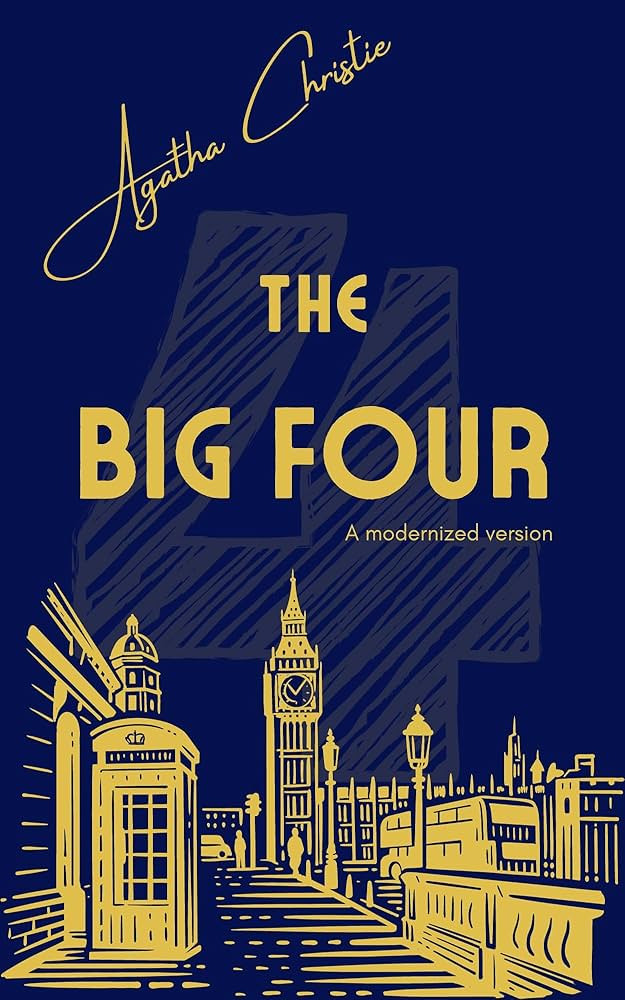
The Big Four
👤| Published | January 1927 |
| Genre | Spy Thriller / Adventure |
| Publisher | Collins Crime Club |
| Language | English |
| Series | Hercule Poirot #5 |
📝My Honest Review: The Big Four
Let's not sugarcoat it: The Big Four is a mess. If you’re looking for a clever "whodunnit" where you can find clues and solve a murder, you are going to be very disappointed. Instead of a village mystery, we get Poirot and Hastings running around the world like they're in a Sherlock Holmes parody, fighting a secret international crime syndicate that wants to take over the world. It’s basically 1920s James Bond, but it doesn't really suit our favorite Belgian detective.
As a critic, I have to point out **why it feels so disjointed**. Christie actually wrote this during a very difficult time in her life (right after her famous 11-day disappearance), and it’s actually a collection of short stories stitched together to make a novel. Because of this, the pacing is all over the place. One minute they're in a mountain hideout, the next they're at a chess tournament. It lacks the tight, logical structure that makes her other books so good.
The "Big Four" villains are also total caricatures—the "evil Chinese mastermind," the "rich American," the "French scientist," and the "English assassin." They feel like comic book villains rather than real people. If you’re a completionist who wants to read every Poirot book, go ahead, but if you're looking for quality Christie, this isn't the place to start.
⏱️ 1-Minute Summary (for busy readers)
A mysterious man collapses in Poirot's bedroom, muttering about "The Big Four." Poirot and Hastings find themselves hunted by an international criminal cartel led by four leaders: a Chinese political genius, an American billionaire, a French scientist, and a master of disguise. The book follows a series of loosely connected adventures as Poirot tries to dismantle their operation.
After several narrow escapes from death, Poirot travels to a secret headquarters in a mountain in Italy. In a theatrical finale, Poirot fakes his own death (with the help of a fictional "twin brother" named Achille) to lure the villains into a trap. He eventually blows up their mountain hideout, ending the global threat. It’s much more of an action-adventure than a detective investigation.
🔹 The Critic's Report Card
| ⭐ Rating | 2.5 / 5 An odd experiment that doesn't quite work for the Poirot brand. |
|---|---|
| 👍 What I Loved | The chemistry between Poirot and Hastings. Even in a bad plot, their friendship is always heartwarming to read. |
| 👎 What I Didn’t Like | The "Achille Poirot" twist. Introducing a twin brother out of nowhere is one of the laziest tropes in fiction history. |
| 😐 Overrated or Underrated? | Properly Rated. Most fans agree this is one of her weakest efforts. |
👤 Human Take: A Writer in Trouble
You can really feel Agatha Christie's personal struggle in this book. It feels like she just wanted to get it finished so she could move on. The "human" element here is seeing a great writer trying to find her feet again after a personal crisis. While the story is ridiculous, there’s something fascinating about watching her experiment with a genre (espionage) that she clearly wasn't as comfortable with as the classic murder mystery.
The Final Word: If you want "Peak Poirot," skip this and go to Death on the Nile. If you want a weird, fast-paced 1920s action flick, give it a shot.
Discover Your Next Great Read
Handpicked recommendations from our collection of literary treasures
💬Discussions