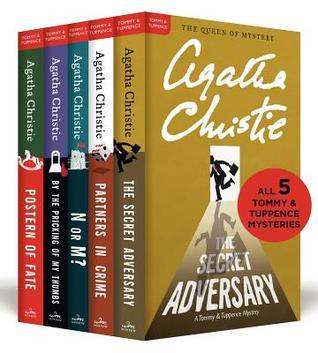
The Complete Tommy & Tuppence Collection
👤| Timeline | 1922 – 1973 |
| Genre | Espionage, Thriller, Mystery |
| Publisher | Various (Collins Crime Club) |
| Language | English |
| Total Books | 5 Full Length Novels |
📝My Honest Review: The Tommy & Tuppence Series
If Poirot is about logic and Miss Marple is about intuition, Tommy and Tuppence are about **adventure**. I find this collection fascinating because we actually get to see the characters grow up, get married, have children, and deal with old age. It’s much more "human" than Christie's other series, even if the plots are sometimes a bit more far-fetched.
Tuppence is the engine of the duo—she is impulsive, charismatic, and often the one who gets them into trouble (and out of it). Tommy is the "solid" one, providing the logic and the muscle. Their chemistry is what makes the books work; they bicker like a real couple, which adds a layer of humor that you don't find in the more serious Poirot books.
The collection varies in quality. *The Secret Adversary* is a fun, post-WWI spy thriller, and *N or M?* is a brilliant WWII espionage mystery. However, I have to be honest: the final book, *Postern of Fate*, is quite rambling and difficult to follow. It was the last book Christie ever wrote, and you can tell she was struggling with her memory at the time. It’s better to read these for the characters rather than just the "puzzle."
Overall, this is a must-have for any Christie fan. It shows a completely different side of her writing—less focused on "clues in a room" and more focused on international spies, secret codes, and the long-term effects of war on society.
⏱️ 1-Minute Summary (The Series Arc)
The collection follows childhood friends Tommy Beresford and Prudence "Tuppence" Cowley. They start in 1922 as "The Young Adventurers," looking for money and excitement in London. They eventually join British Intelligence, hunting down secret agents and Soviet spies during both World Wars.
As the decades pass, they transition from active agents to an older couple living in the country, but they can't help stumbling into cold cases—uncovering old secrets hidden in children's books or investigating murders that happened fifty years prior. It is a journey through 50 years of British history told through the eyes of a single, detective-loving couple.
💡 Key Ideas & Themes
🌱 Life Lessons / Takeaways
- Adventure has no age limit: You can be an "adventurer" at 20 and still be one at 70. Life is as exciting as you choose to make it.
- Find a partner who challenges you: The success of the Beresfords' marriage comes from the fact that they are both working toward the same goals.
- Don't ignore the "quiet" history: Old houses, old books, and old stories often hold the keys to modern problems.
🎯 Who Should Read This?
- Fans of spy thrillers and espionage.
- Readers who enjoy watching characters grow and change over decades.
- Anyone who finds Hercule Poirot a bit too "stiff" or formal.
❌ Who Shouldn't?
- "Logic-only" mystery fans—these plots rely on more luck and action.
- Those looking for a quick read; the later books are quite dense and slow.
🔹 My Honest Rating
| ⭐ Rating (Series Overall) | 4.0 / 5 A wonderful character study, though the plotting is less consistent than Poirot. |
|---|---|
| 👍 What I Loved | The evolution of the characters. Seeing Tuppence go from a "flapper" to a grandmother while keeping her sharp tongue is a joy. |
| 👎 What I Didn’t Like | The final book (Postern of Fate). It’s unfortunately very confusing and lacks the sharpness of the earlier adventures. |
| 😐 Overrated or Underrated? | Underrated. Most people only know Poirot and Marple, but Tommy and Tuppence are arguably Christie's most "relatable" creations. |
| 🧠 What Changed My Thinking | It changed how I view the "Detective" archetype. They don't have to be loners or geniuses; they can just be a couple who enjoys a good mystery. |
👤 Author Context (Behind the Scenes)
Why she wrote this series: Christie stated that she wrote the first book, *The Secret Adversary*, because she was tired of writing about Poirot and wanted "someone younger and more lighthearted."
Author’s mindset: Tuppence is widely considered to be the character most like Agatha Christie herself—independent, curious, and a bit of a risk-taker. You can feel Christie's personal nostalgia in the later books as they look back on their lives.
Reception: While never as popular as Poirot, the series has a very loyal cult following. It was recently adapted into a BBC series called *Partners in Crime* (2015), which brought a new generation of fans to the duo.
Discover Your Next Great Read
Handpicked recommendations from our collection of literary treasures


💬Discussions