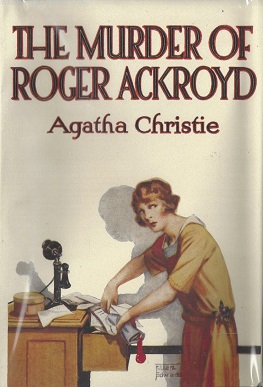
The Murder of Roger Ackroyd
👤| Published | June 1926 |
| Genre | Detective Mystery |
| Publisher | William Collins & Sons |
| Language | English |
| Series | Hercule Poirot #3 |
📝My Honest Review: The Murder of Roger Ackroyd
This is the book that made Agatha Christie a superstar. Set in the quiet village of King's Abbot, it has all the classic ingredients: a wealthy man murdered in a locked study, a house full of suspicious relatives, and a retired Hercule Poirot trying to grow vegetable marrows. As Poirot tellingly remarks to his assistant for the case:
"Everything is simple, if you arrange the facts methodically."
Now, let’s be critical. If you strip away the famous ending, the middle of the book is a very standard, almost slow, village mystery. There’s a lot of talk about dictaphones, footprints, and precisely what time everyone had dinner. If you aren't a fan of the "logistical" side of mysteries, you might find yourself getting a little impatient. But here, the slow pace is a trap. Christie is lullabying you into a sense of security before she pulls the rug out.
The "human" side of this is the narration. Dr. Sheppard, the local physician who helps Poirot, is a fantastic character. He’s dry, observant, and funny. He provides the "normal" perspective that makes Poirot's eccentricities stand out. It’s a brilliant partnership—until it isn't.
⏱️ 1-Minute Summary (for busy readers)
Roger Ackroyd, a man who knew too much about a local widow's suicide and the person blackmailing her, is found stabbed to death in his study. Hercule Poirot comes out of retirement to solve the case, aided by the village doctor, James Sheppard. Every family member has a financial motive or a secret to hide.
The twist is the most famous in the genre: The narrator, Dr. Sheppard, is the killer. He was the blackmailer, and he killed Ackroyd to keep him quiet. He used a dictaphone to faked a conversation with the dead man to create an alibi for the time of death. He was never Poirot’s "Watson"; he was the predator hiding in plain sight, recording his own crime as he committed it.
🔹 The Critic's Report Card
| ⭐ Rating | 4.9 / 5 A masterpiece of misdirection that every mystery fan must read. |
|---|---|
| 👍 What I Loved | The audacity. Christie broke the "unwritten rules" of detective fiction, and she did it so smoothly that you can't even be mad. |
| 👎 What I Didn’t Like | The technicalities. Some of the clues regarding the dictaphone and the moving chair feel a bit dated and clunky by modern standards. |
| 😐 Overrated or Underrated? | Properly Rated. It is consistently voted the best crime novel ever for a reason. |
👤 Human Take: The Ultimate Betrayal
The real "human" element here is the betrayal of the reader's trust. We are trained to trust the narrator, and Christie uses that instinct against us. It makes you realize that in a small town, the most "respectable" person—the doctor—can be the most dangerous. It’s a chilling look at how a "normal" person can justify cold-blooded murder to protect their own reputation.
The Final Word: It’s a brilliant, manipulative, and unforgettable book. Read it once for the mystery, and then read it again immediately to see all the clues you missed the first time.
Discover Your Next Great Read
Handpicked recommendations from our collection of literary treasures
💬Discussions