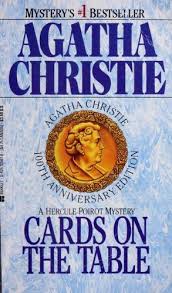
Cards on the Table
👤| Published | November 2, 1936 |
| Genre | Crime Fiction, Mystery |
| Publisher | Collins Crime Club |
| Language | English |
| ISBN-10 | 000711933X |
| ISBN-13 | 978-0007119332 |
📝My Honest Review: Cards on the Table
I just finished *Cards on the Table* and I have to say, this is probably Christie’s most clever "closed-room" setup. Usually, we look for physical clues like dropped handkerchiefs or poisoned drinks. But here? The "clue" is how the suspects play a game of Bridge. It’s a brilliant idea, though I’ll admit, if you don't understand Bridge, some of the middle chapters might feel a bit technical.
The premise is wild: a strange man named Mr. Shaitana invites four "successful" murderers (who got away with it) and four investigators (including Poirot) to a dinner party. While the investigators are playing cards in one room, Shaitana is murdered right in front of them. It’s bold because there are only four suspects, yet Christie still manages to keep you guessing until the very last page.
Hercule Poirot is at his most psychological here. He doesn't care about footprints; he cares about the *scorecard*. He argues that a person's character is revealed in how they gamble. It’s fascinating, but I felt the other "investigator" characters, like Colonel Race and Superintendent Battle, were a bit wasted. They don't do much compared to Poirot.
Overall, it’s a high-concept mystery that feels very modern. It’s less about "whodunnit" and more about "who has the psychology of a killer." If you want a mystery that challenges your brain rather than just your eyes, this is the one.
⏱️ 1-Minute Summary (for busy readers)
The flamboyant Mr. Shaitana hosts a dinner party with a dangerous theme: he invites four people he believes have committed murder and escaped justice, and four crime-fighters to watch them. After dinner, the groups start playing Bridge in two separate rooms. Shaitana sits by the fire in the room with the four "murderers."
By the end of the evening, Shaitana is found dead—stabbed with a stiletto from his own collection. None of the four suspects left the room, and none of the investigators saw anything. Hercule Poirot must use the Bridge scorecards to analyze the suspects' personalities and determine which of them had the daring and the temperament to commit a murder in a room full of people.
💡 Key Ideas & Themes
🌱 Life Lessons / Takeaways
- Everything we do reveals who we are: Even a simple hobby or game reveals your true character if someone is observant enough to watch.
- Don't taunt dangerous people: Shaitana’s death was a direct result of his need to show off his power over others.
- The past is never truly buried: No matter how well you hide a secret, the "psychological pattern" of that secret remains in your behavior.
🎯 Who Should Read This?
- Fans of psychological thrillers.
- Anyone who enjoys Bridge (you'll love the scorecard analysis).
- Readers who like a very small, focused cast of suspects.
❌ Who Shouldn't?
- People who hate card game talk (the Bridge talk is heavy).
- Readers who want a lot of action and chase scenes.
🔹 My Honest Rating
| ⭐ Rating (Story, Writing, Value) | 4.5 / 5 One of the most creative plots Christie ever wrote. A must-read for Poirot fans. |
|---|---|
| 👍 What I Loved | The Bridge Scorecard deduction. It’s so unique—I’ve never seen another mystery solve a crime using a game’s points system. |
| 👎 What I Didn’t Like | The ending felt a little rushed, and I wish we got more of Ariadne Oliver (the eccentric novelist) in the middle sections. |
| 😐 Overrated or Underrated? | Underrated. It’s often forgotten compared to *Death on the Nile*, but the logic here is much tighter. |
| 🧠 What Changed My Thinking | It made me realize that "evidence" isn't always a physical object. Sometimes, a person's *reaction* to a situation is the strongest evidence you can have. |
👤 Author Context (Behind the Scenes)
Why she wrote this book: Christie was an avid Bridge player herself. She wanted to see if she could write a "pure" mystery where the clues were entirely based on the personality of the suspects rather than physical evidence.
Author’s mindset: This book features Ariadne Oliver, who is widely considered to be a "parody" of Agatha Christie herself. Through Ariadne, Christie pokes fun at her own fame and the struggles of being a mystery writer.
Reception: At the time, critics praised it for its originality. It was considered a "high-brow" mystery because of the Bridge element. It remains a favorite for those who like the "fair play" style of mystery where the reader has all the clues.
Discover Your Next Great Read
Handpicked recommendations from our collection of literary treasures


💬Discussions