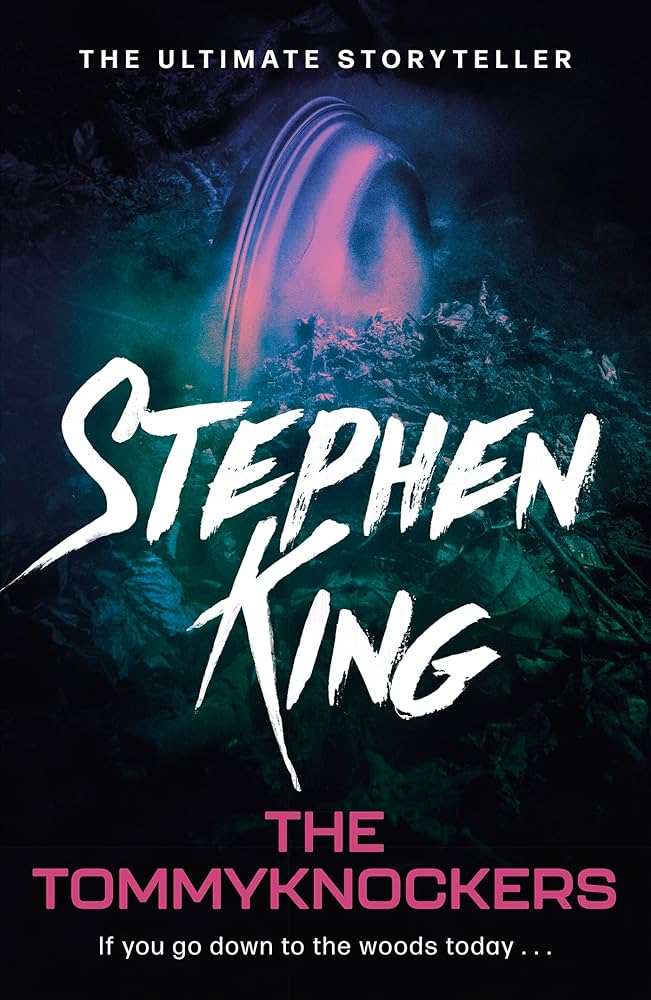
The Tommyknockers
👤| Published | November 1987 |
| Genre | Sci-Fi / Horror |
| Publisher | Putnam |
| Language | English |
| POV | Multiple / Third Person |
📝My Honest Review: The Tommyknockers
The story starts with Bobbi Anderson, a writer who trips over a piece of metal sticking out of the ground in her backyard. She starts digging, and it turns out to be a massive, ancient spaceship. The ship begins to "emit" something that turns the local townspeople into geniuses—but also into telepathic, decaying monsters. The rhyme that haunts the book sets the tone:
"Late last night and the night before, Tommyknockers, Tommyknockers, knocking at the door. I want to go out, don’t know if I can, 'cause I’m so afraid of the Tommyknocker man."
Now, let’s be critical. This book is **way too long**. There are hundreds of pages of town history and weird subplots that don't go anywhere. It feels like King had ten different ideas for a book and just decided to glue them all together. There's a flying vending machine, a murderous water heater, and some very gross body horror that feels like it’s trying too hard to shock. It’s bloated and lacks the "tightness" of Misery or Carrie.
However, the creative energy is undeniable. The concept of "becoming" something else—losing your teeth and your humanity in exchange for brilliant, dangerous ideas—is a direct metaphor for drug use. It’s a very raw, albeit messy, look at how a person (or a town) can be consumed by an external force until there’s nothing left of the original person.
⏱️ 1-Minute Summary (for busy readers)
Bobbi Anderson unearths a UFO in Haven, Maine. The townspeople begin "becoming," gaining high-tech knowledge and telepathy but losing their physical health and individual identities. Bobbi's friend, Jim "Gard" Gardener, is a poet and an alcoholic whose metal plate in his head makes him immune to the ship’s influence. He watches in horror as his friend and the town transform into a hive mind.
The "Tommyknockers" aren't actually aliens; they are a parasitic psychic energy that inhabits the ship. In the chaotic finale, Gard realizes the only way to save the world is to destroy the ship. He manages to launch the ship into space, killing himself in the process but ending the "becoming." Most of the townspeople, whose lives were tied to the ship, die shortly after. It is one of King's most cynical and destructive endings.
🔹 The Critic's Report Card
| ⭐ Rating | 2.5 / 5 A fascinating, bloated disaster of a book. |
|---|---|
| 👍 What I Loved | The Gothic Sci-Fi vibes. When King sticks to the horror of the transformation, it’s genuinely unsettling. The "inventions" the townspeople make are weirdly creative. |
| 👎 What I Didn’t Like | The Lack of Editing. It needs about 300 fewer pages. The tone shifts wildly from serious horror to goofy sci-fi in ways that don't always work. |
| 😐 Overrated or Underrated? | Properly Rated. Most people know it’s one of his weaker efforts, but it’s a "must-read" if you want to see King at his most experimental. |
👤 Human Take: The Cost of Brilliance
The "human" tragedy here is the loss of self. The people of Haven think they are becoming better, smarter, and more advanced, but they are actually losing their souls. It’s a powerful allegory for how we can trade our humanity for progress or "shortcuts." Gard, the "broken" alcoholic, ends up being the hero because his "flaw" (the metal plate) is the only thing that keeps him human. It’s a story about why being imperfect is better than being "perfectly" alien.
The Final Word: It’s a wild, bumpy ride. It’s definitely not his best work, but it’s a fascinating glimpse into a master writer losing control of his craft—and then finding a way to finish the story anyway.
Discover Your Next Great Read
Handpicked recommendations from our collection of literary treasures


💬Discussions