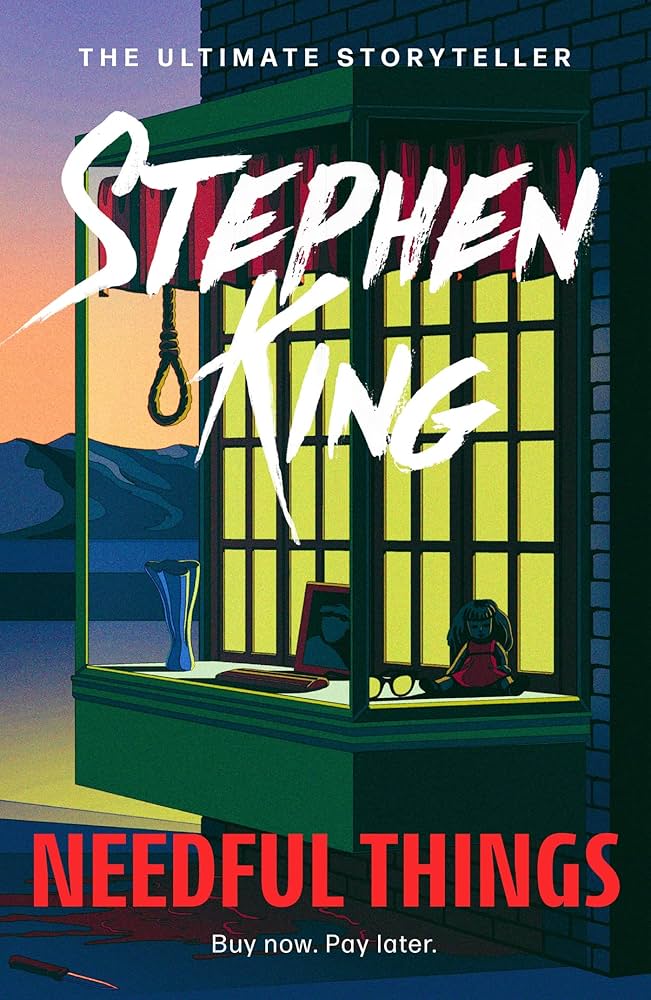
Needful Things
👤| Published | October 1991 |
| Genre | Supernatural Horror / Satire |
| Publisher | Viking |
| Language | English |
| POV | Multiple / Third Person |
📝My Honest Review: Needful Things
A new shop opens in Castle Rock, Maine, called "Needful Things." The owner, a charming old man named Leland Gaunt, always has exactly what you desire most—a rare baseball card, a cure for arthritis, a fragment of Noah's Ark. He doesn't want much money; he just wants you to do a "small favor" (a prank) for him. As the shop's sign suggests:
"You’ve been here before. You know the way."
Now, let’s be critical. This is one of King’s longest and meanest books. Because it involves dozens of characters, it takes a long time (about 300 pages) to really get moving. Some readers find the sheer number of subplots exhausting. Also, the tone is incredibly cynical—King is basically mocking his own characters for being so easily manipulated by "stuff." If you like your horror with a bit of heart (like IT), this might feel a bit cold and clinical.
The human horror is in the "pranks." Gaunt has one person play a prank on another, leading them to believe someone else did it. He uses their existing grudges and paranoias as fuel. It shows how fragile a community's peace really is. By the end, the "small favors" have escalated into a full-scale civil war with bombs and shotguns. It’s a terrifying look at how easily "good people" can be convinced to murder their neighbors over a piece of memorabilia.
⏱️ 1-Minute Summary (for busy readers)
Leland Gaunt (who is revealed to be a demon/devil figure) spends the book collecting the souls of Castle Rock's citizens by trading them objects they "need." He orchestrates a series of overlapping "tricks" that turn neighbor against neighbor—Catholics vs. Protestants, the Sheriff vs. the town selectman.
The finale is a chaotic explosion. Most of the town is destroyed as the citizens hunt each other down in a madness fueled by their "needful things." Sheriff Alan Pangborn is the only one who realizes what's happening. In a final showdown, he uses "white magic" (and some sleight-of-hand tricks) to force Gaunt out of town. Gaunt leaves, taking a suitcase full of souls with him, and moves on to the next town to open a new shop. It’s a bleak ending that suggests evil is just a business that never goes out of style.
🔹 The Critic's Report Card
| ⭐ Rating | 3.8 / 5 A brilliant concept that is slightly buried under its own weight. |
|---|---|
| 👍 What I Loved | The Villain. Leland Gaunt is one of King's best antagonists. He’s not a slasher; he’s a salesman. He wins by being polite and giving people exactly what they asked for. |
| 👎 What I Didn’t Like | The Bloat. There are about 150 pages of character introductions that could have been trimmed to make the descent into chaos feel punchier. |
| 😐 Overrated or Underrated? | Properly Rated. It’s recognized as a solid King epic, but it lacks the "magic" of his early Castle Rock work. |
👤 Human Take: The Price of Possession
The "human" truth of Needful Things is that we often own things that eventually end up owning us. King isn't just writing a horror story; he's writing about the 1980s/90s consumerist boom. He's asking: what are you willing to give up for that thing you’ve always wanted? Your integrity? Your neighbor’s safety? Your soul? It’s a cautionary tale about how our desires can be used as weapons against us.
The Final Word: It’s big, it’s loud, and it’s messy. It’s a grand farewell to Castle Rock that leaves the town in ashes—which is exactly what it deserved.
Discover Your Next Great Read
Handpicked recommendations from our collection of literary treasures
💬Discussions